Role: Voluntary evaluator | AWL Research Evaluation Panel
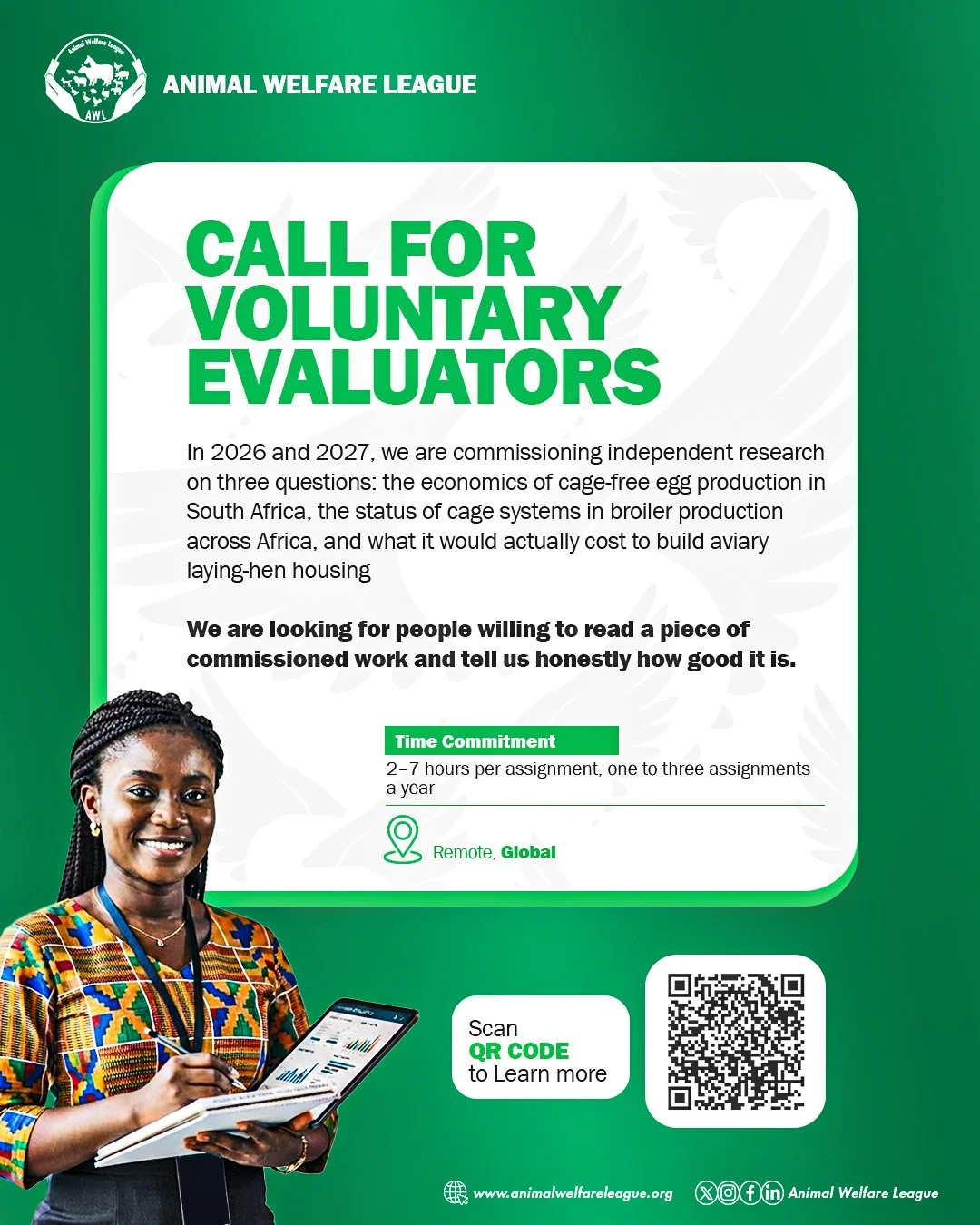
Time commitment: 2–7 hours per assignment, one to three assignments a year
Location: Remote, Global
Applications: Rolling.
Panels for the 2026 – 2027 studies are being formed now
Why we are asking
The Animal Welfare League works to improve farmed animal welfare across Africa, with a focus on chickens and fish, in Ghana, Morocco, South Africa and Egypt.
In 2026 and 2027, we are commissioning independent research on three questions: the economics of cage-free egg production in South Africa, the status of cage systems in broiler production across Africa, and what it would actually cost to build aviary laying-hen housing in Nigeria, Egypt, and South Africa. This research will be published openly, and some of it will go to standards bodies and regulators. It will be read closely by people who would prefer it to be wrong. That is why we are not assessing it on our own.
We are looking for people willing to read a piece of commissioned work and tell us honestly how good it is. Every panel includes at least one member independent of AWL, and panel composition is published.
What an evaluator does
You will be sent completed work — a research proposal, an economic analysis, or a scoping paper — together with a one-page scoring rubric published in advance. You score it, add brief comments, and send it back. Where a panel needs to talk, we hold one short call.
You are scoring for rigor, correct use of evidence, honesty about uncertainty, and whether a standards body could act on the work. You are not scoring for whether the findings help AWL. Our calls expressly state that work is not assessed by reference to the direction of its findings, and that the provision binds the panel as much as the authors.
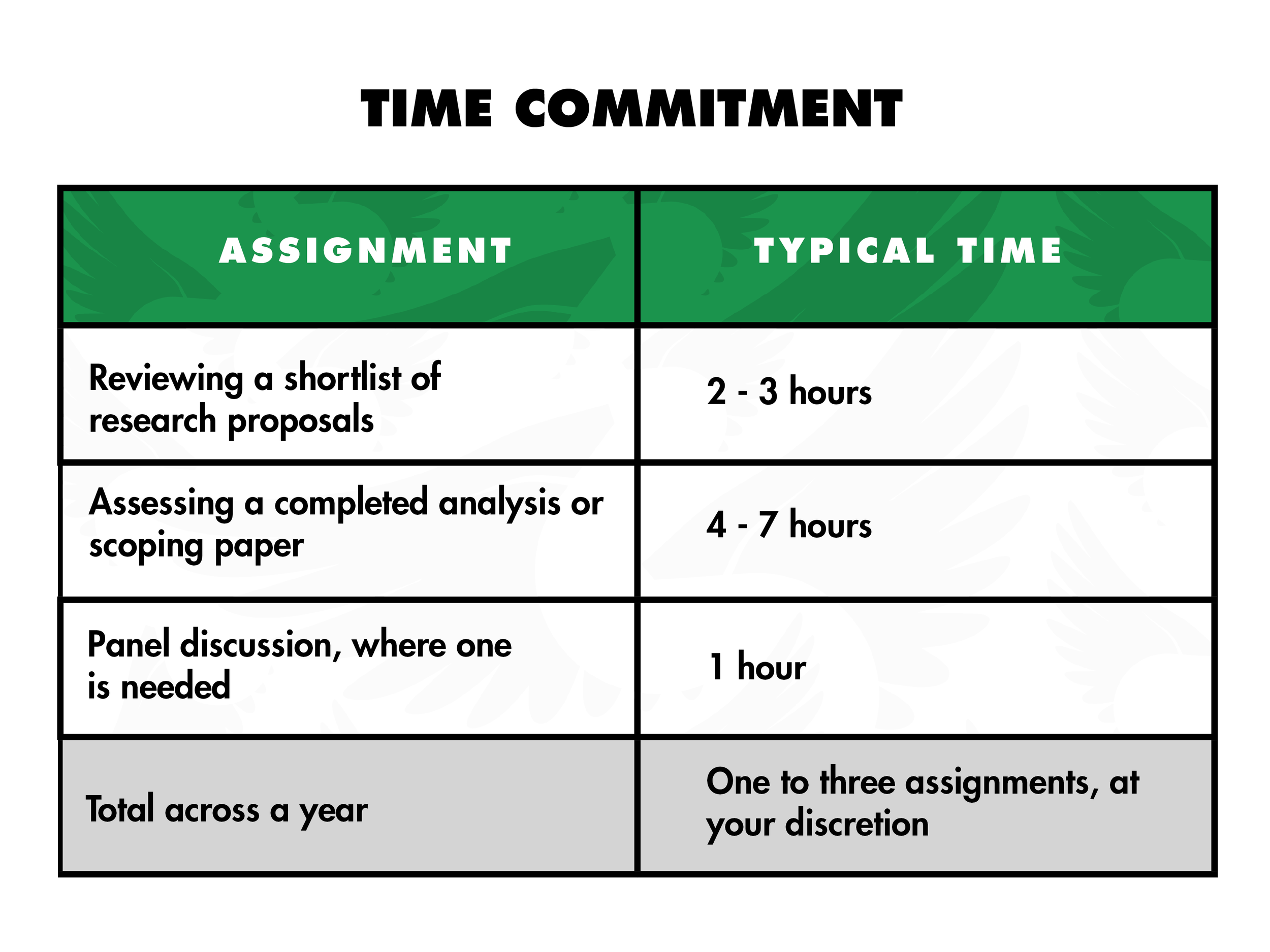
We will always tell you the deadline before you accept an assignment, and it will be at least 2 weeks. You may decline any assignment without explanation, and declining does not remove you from the panel.
Who we are looking for
We need a mix of expertise across the panels, not all of it in any one person. We would like to hear from you if you have working knowledge of any of the following:
Agricultural, livestock or applied economics
Poultry production science, including layer and broiler systems
Commercial poultry in an African market, from any vantage point: production, processing, retail or supply
Standards development, regulation or public policy processes
Statistics, econometrics or quantitative methods
Trade, customs and supply chain analysis
Agricultural engineering, construction costing or quantity surveying
You do not need prior involvement in animal welfare. Several of the questions our panels assess are ordinary problems in applied economics, statistics, or engineering, and we would rather have a rigorous assessor who is new to the subject than an advocate.
We particularly encourage evaluators based in Africa, and evaluators who have worked in the markets the research covers.
What we ask of you
Honesty about the work. Including telling us that something we commissioned is weak, or that a finding we would like to be true is not supported.
Honesty about yourself. Every panel member completes a declaration of interests covering any relationship with the South African Poultry Association, the National Agricultural Marketing Council, the Consumer Goods Council of South Africa, poultry producers or processors, poultry industry bodies, and manufacturers of poultry housing equipment. A relationship does not disqualify you. Not disclosing one does.
A reply either way. If you cannot take an assignment, saying so promptly is more useful to us than a maybe.
Confidentiality until publication. Submissions are confidential to the panel until the work is published.
What you get
A token honorarium of US$250 per completed assessment. The role is voluntary and many reviewers decline the honorarium or ask that it be redirected. We offer it because we do not think expertise should be free by default.
Named credit. Panel composition is published when each call closes, unless you ask not to be named.
Early sight of the research, and of the underlying data, which is published openly alongside every commissioned output.
A say in what gets commissioned next. Every study we commission asks its authors to state what they could not determine. That list becomes the following year’s research questions, and the panel sees it first.
What we will not do
We will not ask you to chase authors, edit their work, or resolve disputes.
We will not put you on the critical path. AWL retains decision authority and holds a paid fallback assessor, so a panel member who goes quiet does not stall an award.
We will not ask you to endorse a finding, or to sign anything beyond your own scores and comments.
How to apply
Write to careers@animalwelfareleague.org with the subject line "Research Evaluation Panel". Tell us in a few lines:
which areas of expertise above you can cover;
the markets or countries you know;
roughly how much time you could give in a year; and
any relationship that would need to go on a declaration of interests.
A CV or a link to your publications is welcome but not required. We will respond either way.
Applications are considered on a rolling basis. Panels for the three 2026–27 studies are being formed now, and we expect the first assignments to be issued in October 2026.
Contact